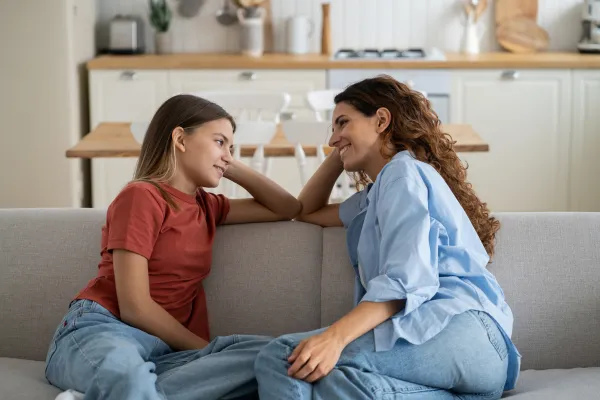
Why Your Teenage Daughter Doesn't Need You To Be Friend (She Needs Something Far More Powerful)
There's a trend I keep seeing on TikTok right now. Moms trying to speak Gen Alpha slang with their teenage daughters in an earnest attempt to feel closer to them. You can almost see the hope in their eyes as they deliver a line they've rehearsed, waiting for the laugh or the warm moment of connection they're desperate for.
And instead, they get the eye roll.
I understand why it happens. When your daughter suddenly retreats to her room, stops sharing, gives you one-word answers, and starts treating you like a stranger in your own home, the instinct is to close that gap however you can. Mimicking her language feels like a small, harmless bridge.
But here is what's actually happening on her end: instead of feeling connected, she's wondering why mom is trying so hard. What's her agenda? Why is this so out of character? By trying to be someone you're not, you can unintentionally come across as manipulative, and she picks up on it immediately.
Your teenage daughter doesn't need you to be her friend. She doesn't need you to be her 17-year-old peer.
She needs you to be her safe place.
The Shift Nobody Prepares You For
I get messages from moms every single week saying some version of the same thing. "We used to be so close. Now she won't even talk to me. Why is she hiding in her room?"
And they take it deeply personally.
Here's the piece that changes everything when you understand it: this pulling away is not a rejection of you. It's developmentally appropriate. Evolutionarily, this is the age when a young woman begins to separate from her childhood tribe, find a mate, and join a new one. She is biologically wired right now to discover her own identity, her own values, her own interests, and where she fits in socially.
Her close peer friendships are a huge part of this phase, not a replacement for you. Naturally, she is pulling away from the child she used to be in your household because she is actively becoming someone new.
Your biggest contribution during this phase is not to force connection. It's to be the safe, judgment-free space where she can explore who this new person is, ideally with you as a witness rather than a gatekeeper. Because when she senses judgment or pressure, she learns one thing very quickly: she needs to hide the process from you.
And once she learns to hide, rebuilding trust becomes exponentially harder.
Why Forcing The Conversation Backfires
I worked with a mom recently who was determined to get her daughter to open up. She was asking her about her day constantly, pushing for details, trying to create those "big" heart-to-heart moments she remembered from when her daughter was younger.
It wasn't working. In fact, it was making things worse.
What I recommended instead were low-conflict, side-by-side activities. Running errands together. Doing chores at the same time. Listening to music on the drive to and from school. No demands. No expectations of deep sharing.
Within weeks, her daughter started initiating conversations on her own.
Here's why: being present without needing to talk about something gave her daughter the quiet message that she was okay, even when she didn't perform emotional openness on command. That low pressure is what created the safety. And from that safety, she chose to come closer voluntarily.
When you stop taking her need for space personally, you actually create the environment where she can leave her room and come to you when there's nothing forcing her to.
Stop Trying To Fix Her
I work with a lot of high-achieving professional moms, and they bring a real strength to parenting: they're trained to identify problems and solve them efficiently. That works brilliantly at work.
It often does not work with your teenage daughter.
That’s because you cannot use logic to solve emotional problems. And when you try, you accidentally communicate something that lands hard in her developing sense of self: I'm my mom's problem to fix, or my mom doesn't trust me to figure things out on my own.
Neither of those feelings builds connection. Both of them teach her to hide and avoid.
So if you catch yourself constantly wanting to fix or manage her, even with the best intentions, I want you to pause and ask yourself one honest question: what expectation is she not meeting right now?
Because the word "expectation" points toward something important. Whose expectation is it, really? Is it genuinely hers? Or is it yours, inherited from the expectations once placed on you, and now unconsciously projected forward onto her?
This is the inward work that actually changes the relationship. When you separate her from the version of her you're unconsciously projecting, something softens in you. You stop managing and start wondering. You get genuinely curious about her goals, her emerging identity, who she's becoming.
And trust me, she can feel the difference immediately.
What Being A Safe Place Actually Looks Like
Being her safe place is not about being passive or permissive. It's being grounded. Curious. Self-regulated in moments when she is not. It's holding your boundaries with warmth instead of shame.
It's staying calm when she's melting down, because she's watching your nervous system to learn what to do with hers.
It's modeling the values you want her to carry, not lecturing them.
It's letting her come to you rather than chasing her into her room.
This is the work I walk mothers through inside The SAFER Method, where you learn how to bring your grounded presence, consistently offered, with no agenda attached.
That is the bridge she will eventually cross. Not because you built it with the right words, but because you stood on your side of it long enough for her to trust it would hold.
If this resonated with you and you are ready to explore what that looks like in your own life, I invite you to comment below or visit www.dream-method.com/teens-safer to learn more about how the SAFER Method helps mothers and families navigating exactly this.